
163 in this dataset
9 developers pursuing it
12 organisations in FR
What these terms mean
Every classification on this page, defined. These are controlled-vocabulary terms, so the same word means the same thing on every profile.
- Fusion developer
- Develops a fusion device or power plant concept. Carries no implication that the device exists or works.
- Fusion
- Organizations pursuing energy from nuclear fusion, and their dedicated supply chain.
- Stellarator › › Stellarator
- Confinement produced entirely by external coils twisted into complex three-dimensional shapes, with no current driven through the plasma. Far harder to build than a tokamak and inherently steady-state rather than pulsed.
- Deuterium–tritium
- Lowest ignition threshold; 80% of energy in 14.1 MeV neutrons. The reference fuel for every near-term net-gain claim.
In Renaissance Fusion’s own words
Quoted from the organisation’s own site as we archived it. Their description of themselves, not ours, and not a claim this site has checked.
But not anymore, thanks to our unique technologies! Our simplifications have clear competitive advantages in the race to the first power-plant.
We are proving that simple, elegant coils can generate complex magnetic fields. In other words, we decouple engineering from physics: we build 1D or 2D coils (typically on cylindrical surfaces, not necessarily of circular cross-section) to generate the 3D magnetic fields needed in stellarators and several spin-offs.
Only High Temperature Superconductors (HTS) can generate the high magnetic fields needed to make fusion smaller and cheaper. The benefits are impressive: a 4x increase in magnetic field reduces the plasma volume by 256x. The problem is that these man-made materials are scarce and expensive, but at Renaissance Fusion we are skipping some intermediate steps (tapes, cables) and directly depositing and patterning HTS on large surfaces. It’s like changing paradigm from individual transistors to photolithography. We think it will be a big revolution.
Our liquid Lithium-based walls stop 99.99% of the neutron energy before they can reach solid materials and make them radioactive. Brute force would require a 1.5 meter thick liquid wall. With clever materials, we do it in 40 cm.
Thirdly, it breeds one of the fuels: Tritium. Our liquid materials allow Li tritide extraction by simple precipitation.
We are the only magnetic fusion entity, public or private, that surrounds the plasma with a liquid wall thick enough to stop most neutrons. Surrounding the plasma is necessary because neutrons are emitted in all directions.
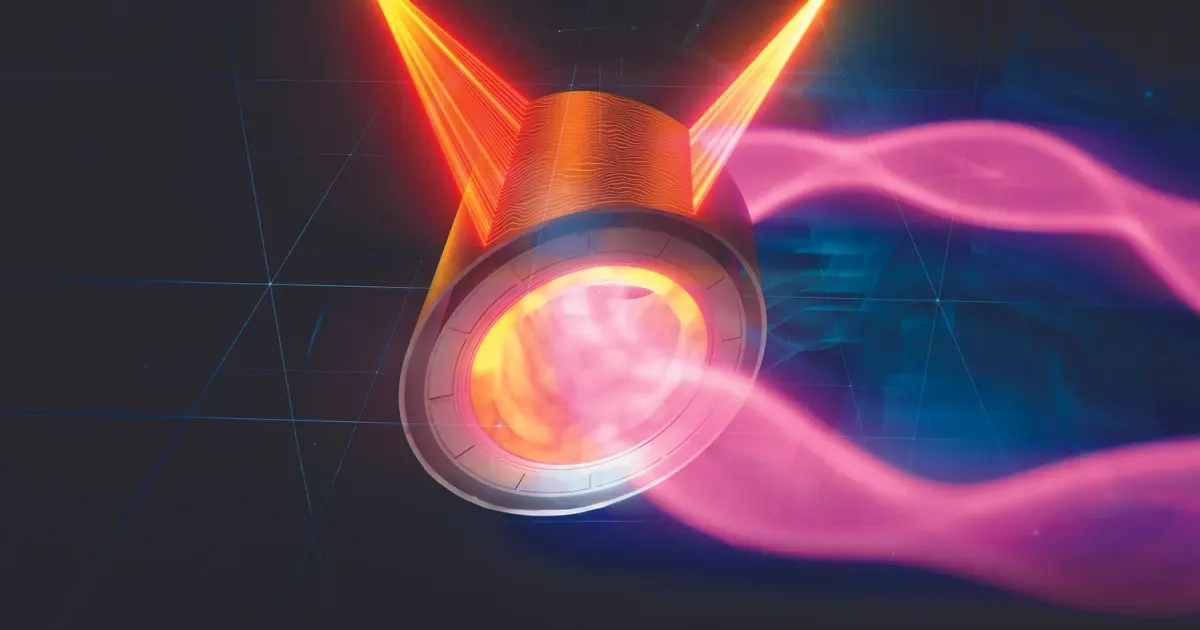
We obtain this by circulating a small electric current (dashed line) in the liquid metal (blue), via electrodes (+,-). The current interacts with the strong magnetic field B that confines the plasma. As a result, the liquid metal injected from the top of a cylinder does not fall vertically, but along its solid walls, and shields them.
We do the reverse: we adopt simple surfaces, at the cost of more complex current patterns on those surfaces. This cost is negligible for us: just a different programming of the laser engraving. The net result is leaner, faster, cheaper manufacturing, easier maintenance and transportability.
We skip tapes and cables altogether and directly deposit the relevant films on large surfaces, then engrave them with a laser. The laser can draw complicated circuits, generating complex magnetic fields. Simple multi-layer deposition replaces tape stacking and multi-turns.
Commissioned the MOCVD roll-to-roll system on a 20-m long, 24-cm wide Hastelloy tape. Commissioned our oxygen furnace.
Commissioned the vacuum system of our first PVD machine, as well as its roll-to-roll system (on a 10 m long, 24 cm wide Hastelloy tape). Installed the fluid distribution lines and deposition systems.
First in-house batch of GaInSn: we “cooked” the alloy in house as in “Breaking Bad”. This is the same material found in your mercury-free thermometer, in ml quantities, but we cooked tens of liters, in a brewery pot.
Our first table-top liquid metal loop, built with parts from “Leroy Merlin” (a European “Home Depot”).
Our first liquid metal pump built in-house, by arraying permanent magnets on a rotor, with a whooping 110 kW maximum power.
Completed our in-house 3D free-surface Liquid Metal (LM) Magnetohydrodynamics (MHD) code and successfully benchmarked it against experimental results. Now regularly used to predict and interpret LMMHD experiments.
First levitation and control of a very thick liquid metal flow in a cylinder. The cylinder diameter (1 m) approaches reactor scales, and the flow thickness (10 cm of GaInSn, equivalent in mass to 120 cm of Li-LiH) exceed by 3.5x our reactor needs. Compared to Skyfall 1a, we also greatly reduced the fall of droplets that could radiatively collapse the plasma (“Skyfall 1b”).
Identified two “finalist” solid materials that will withstand dynamic corrosion by hot liquid metals in our stellarator reactor (only few microns per day).
Completed our first large Annular Linear Induction Pump (ALIP) for hot Sn, Li and other metals – the first company and one of only 2-3 organizations worldwide to ever build and ALIP of that scale and the first one, ever, capable of operating at up to 850 C.
Where Renaissance Fusion sits
Composed from records in this dataset, not from outside research. Every figure below is counted from what the site holds, so it moves when the data does.
Renaissance Fusion is one of 9 organisations in this dataset pursuing stellarator.
It is one of 12 we hold in FR.
Related organisations
Others pursuing the same approach, then others in the same country.
Pursuing the same technology
Others in this dataset working on Stellarator.
Sources
- Renaissance Fusion operator
A source marked operator is the subject’s own publication. That is legitimate, and it is not independent confirmation. Methodology.