
Proxima Fusion
🇩🇪 Munich, DE · Founded 2023 · Active
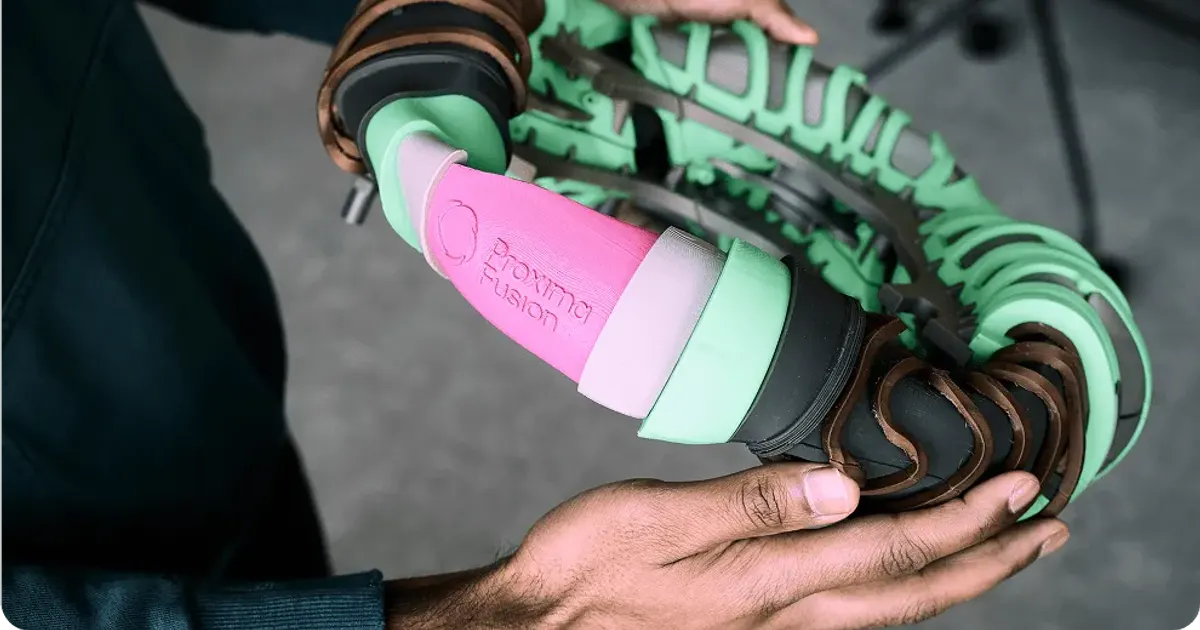
Proxima Fusion is a Munich company founded in April 2023 as a spin-out of the Max Planck Institute for Plasma Physics (IPP), with which it continues to work. It designs quasi-isodynamic stellarators, a type of stellarator whose twisted magnetic coils are shaped so that the net current around the plasma cancels out, using high-temperature superconducting magnets and building on results from IPP's Wendelstein 7-X. In February 2025, with IPP, KIT and other partners, it published a concept for a power plant called Stellaris. It says it will complete a Stellarator Model Coil in 2027 to test its magnet technology and plans a demonstration stellarator, Alpha, to begin operating in 2031 with the aim of producing more fusion energy than the heating put in. In June 2025 it announced a €130 million Series A, co-led by Cherry Ventures and Balderton Capital.
- Sector
- Fusion
- Technology
- Stellarator
- Fuel
- Deuterium–tritium
- Role
- Fusion developer
It is the operator of record for Alpha (Proxima Fusion) (planned) and Stellaris (planned).
Its recorded equity, about $622m, is the 9th largest of the 25 organisations with a priced round here. Not every round is on record, so this is not its total raised.
Terms
- Stellarator
- Confinement produced by external coils twisted into complex three-dimensional shapes, so no net current has to be driven through the plasma. That removes the disruptions a tokamak's plasma current can cause and allows continuous operation, at the price of coils that are far harder to design and build.
- Deuterium–tritium
- Lowest ignition threshold; 80% of energy in 14.1 MeV neutrons. The reference fuel for every near-term net-gain claim.
Funding
- 2026-07-07Equity roundEUR 411 million financing round announced 7 July 2026, led by XTX Ventures and East X Ventures with RWE and Google as strategic investors. The company states a valuation of EUR 2.4 billion without saying whether it is pre- or post-money, so no valuation field is set. The release does not name the round; no round label is recorded. The release's "more than EUR 650 million ... including EUR 95 million in public grants" is the company's cumulative figure and mixes grants with equity. Bavaria's EUR 400 million public funding commitment to the Alpha project is separate and is not a deal here.≈$444m
- 2025-09-09Equity round · Series AEUR 15 million extension of the Series A, announced 9 September 2025, with CDP Venture Capital, the European Innovation Council Fund and Brevan Howard Macro Venture Fund as new investors. Only the increment is recorded; the EUR 130 million Series A is a separate record. The release's "total funding to EUR 200 million" is cumulative and is not a deal.≈$16m
- 2025-06Equity round · Series ASeries A of EUR 130 million (the release gives $150 million), announced as closed on 11 June 2025. Co-led by Cherry Ventures and Balderton Capital, neither of which has an organisation record yet.≈$140m
- 2024-07-15GrantEIC Accelerator award announced 15 July 2024: a EUR 2.5 million grant plus the opportunity of a EUR 15 million equity investment from the EIC Fund. Only the grant is recorded here. The equity arrived later as part of the September 2025 Series A extension and is counted there.≈$3m
- 2024-04-10Equity round · SeedSeed round of EUR 20 million announced 10 April 2024, led by redalpine, with Bayern Kapital, DeepTech & Climate Fonds and the Max Planck Foundation among participants. The release also mentions an earlier EUR 7.5 million pre-seed, but gives no date for it, so that is not recorded.≈$22m
Devices
Related companies
Sources
- Proxima Fusion | Building stellarators to power the futureoperator
- Proxima Fusionaggregator
- Proxima Fusionoperator